
Let’s Debunk Some Foot Products!
But also, there are some things that actually work.
Hello!
Welcome to the body horror issue. I did not really intend this to be the overall theme, but be warned that I’m going to talk about bunions. And root canals. And Madonna. But in a helpful way? Anyway, I have noticed that whenever I meet up with my friends, one of the first topics of conversation is all the ways our bodies are falling apart. To me, it’s a form of intimate bonding. Please feel free to share all your sprains, aches, and weird lab results with me — I am always interested.
I’m thinking about feet a lot lately, mostly because one of mine has been kind of messed up for a while. And, of course, the internet knows this is a chief interest of mine and has fed me countless foot products, many of which I was influenced to buy. I’m betting that some of you might have some interest in this too, so I called a podiatrist to ask her what’s BS and what isn’t.
**Due to length, you may need to read this email in your browser. I never use affiliate links or get paid to recommend things, but I do sometimes receive products for free because of my job, which I’ll note when applicable.
Liking, commenting on, and sharing this newsletter really helps people discover it, which helps ME. (And paying for it? That’s the best way to support my work.) Thank you!
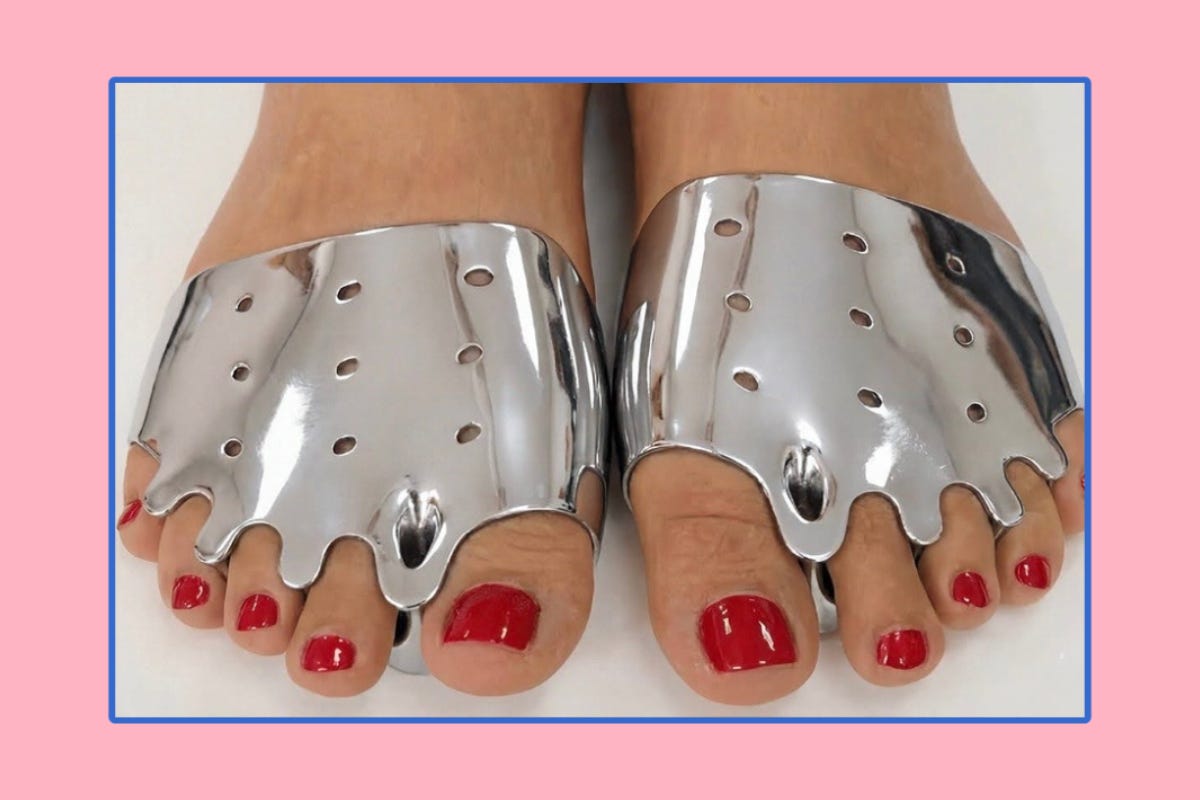
There’s a chance that a good chunk of people over 40 are (or will be) dealing with some sort of foot issue. The feet have four layers of tiny, intricate muscles. Hormonal changes during perimenopause can cause you to lose the protective fat padding on your feet, just like what happens to your face. Then there’s the increased risk for foot fractures due to bone density loss. Add in years of wearing high heels, and things can get dicey. When something gets messed up in your feet, it can affect your mobility and throw body mechanics out of whack.
Enter the brands trying to make money from people (hi, it’s me) desperate to fix their feet. Dr. Lori S. Weisenfeld, DPM, a New York City sports podiatrist, was kind enough to hop on a call with me one evening to gamely answer some questions about gimmicky foot products:
Yoga Toes/Toe Spacers
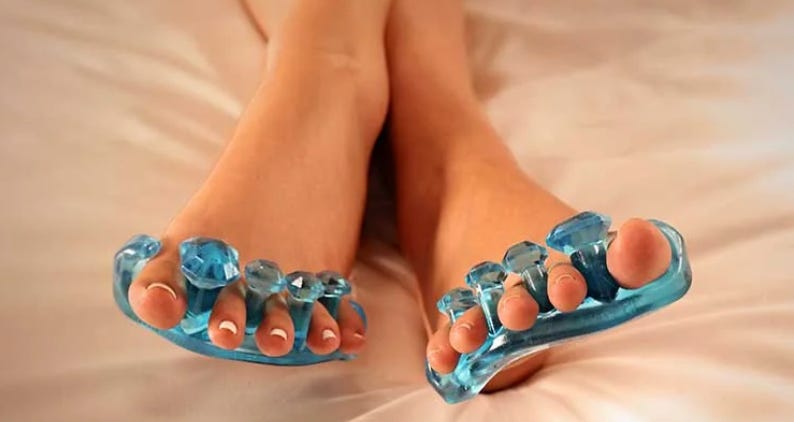
I wanted Yoga Toes ($36.95) to be my salvation. These large, squishy, aqua-colored gel toe-stretchers claim to “knock out chronic foot pain, bunions, bunionettes,1 hammertoes, plantar fasciitis, and overlapping toes.” For a while, I was wearing them for 15 to 30 mins at a crack every night. They feel good, in an uncomfortable way, if that makes sense.
But they’re not going to help fix bunions, one of the most common claims I see online, and the reason I got them.
“They honestly will not help correct the bunion, and they won’t even help slow the progression of the bunion,” says Dr. Weisenfeld. Oh. “People use them for so many different things that they really may not help with and can possibly even hurt.”
If you have a toe injury, they can potentially make that worse. But she says it’s fine to use them to stretch out your joints and ligaments for a few minutes at a time, but don’t expect miracles.
The same goes for toe separators and Visco gel wraps. You can buy these single toe spacers at drugstores. They’re usually meant to be placed between the big toe and second toe, for preventing irritation when bunions cause the toes to press together, or when there’s an ingrown toenail. They’re never going to fix a bony issue, which is what a bunion is, says Dr. Weisenfeld. Neither will nighttime “bunion-correcting” splints or braces.
Verdict: Meh.
Compression Socks
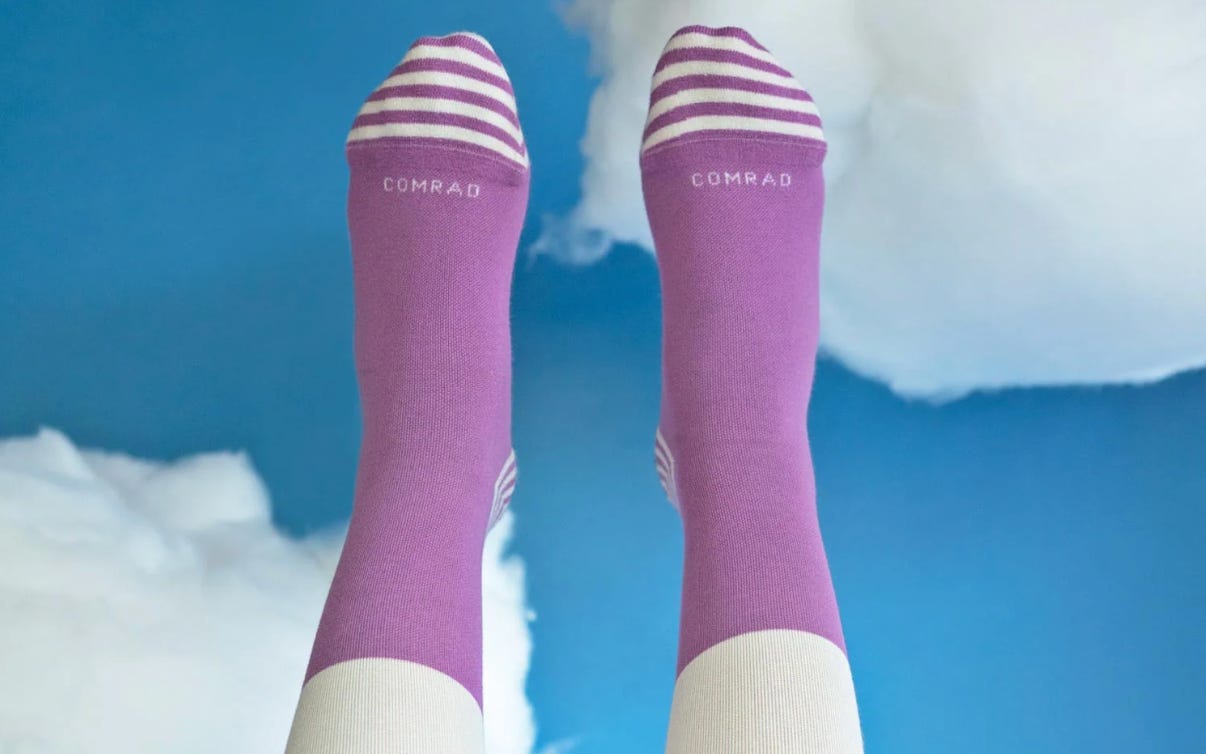
I recommend these to everyone. After I take my Yoga Toes off, I usually put these socks on, and they are heaven. Compression socks have had a 70 percent increase in interest in the past year compared to the previous five years, according to Google Trends. Last year, a Business Insider article said we can thank millennials for “trying to make them cool.” I actually am thankful.
I was also happy to hear that they are a legit and useful product. “Using compression socks after exercise, after when your muscles and your feet are engorged, can help speed the return of the blood and the waste that is created in the muscles while you’re exercising,” says Dr. Weisenfeld. (That “waste,” like lactic acid, is what contributes to soreness.) There’s evidence they can help with delayed-onset muscle soreness, which can happen a day or two after you exercise. You can wear them while exercising too.
They work by facilitating circulation. Your veins return blood to your heart via one-way valves, and the compression socks help that process along by squeezing gently against gravity, preventing inflammation and fluid build-up. Dr. Weisenfeld says to look for socks that have graduated pressure, meaning they’re tightest by the ankle and then loosen higher up the calf. Think about squeezing a tube of toothpaste up your leg.
There are so many new “fashionable” brands that are all over social media. (I’m writing this with scare quotes because these are knee-length nylon socks we’re talking about. There’s only so much you can do with them.) Lately, I’m getting ads for a brand called Wellow, which claims to have cooling compression socks for summer wear. I like Comrad. Other brands that are popping off, according to Google Trends: Nurse Yard, Everstride, Bombas, Viasox (um, the designs here are wacky), Clove.
Verdict: Sure, buy some!
Zero-drop Shoes
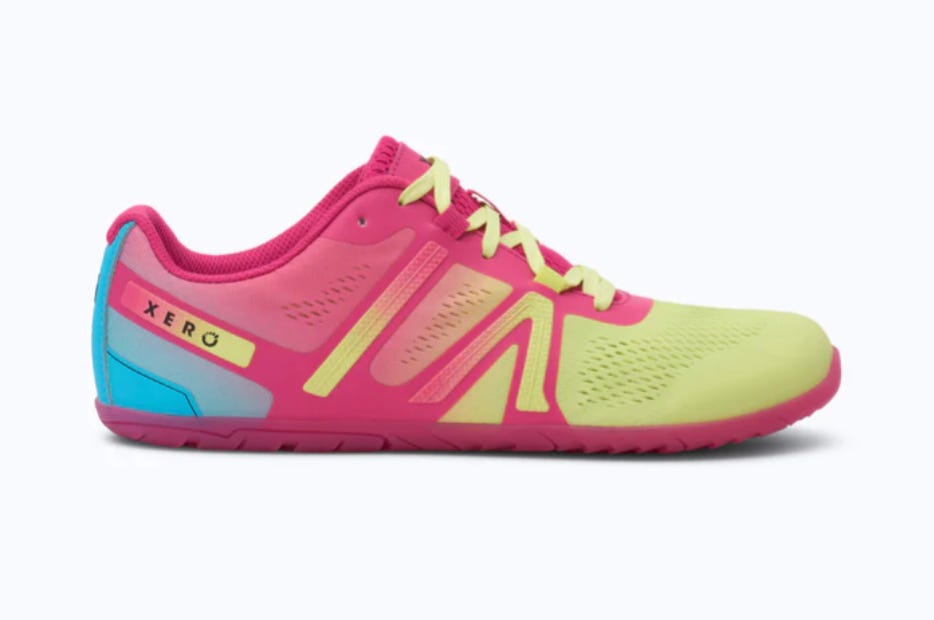
These got popularized thanks to the barefoot running community, but I’m not talking about those insane Vibram toe shoes. “Zero-drop” just means that your heel and toe are at the same level. (See: classic Birkenstock sandals, ballet flats, Converse All Stars.) Often, shoes, even sneakers, are constructed so that the heel is higher than the toes. Zero-drop shoes can still have squishy outsoles; it’s just an overall measure of insole flatness.
I first became aware of the concept a few years ago when I started getting serious about lifting weights. I wear Xero for lifting, and they are not attractive, though the brand has done some collaborations with fashion brands. Zero- or low-drop shoes work best for my issues. I find them the most comfortable to walk around in. But!
“Zero-drop shoes aren’t good for everyone,” says Dr. Weisenfeld.
Anecdotally, she says she has patients with knee and back pain who found that they improved those symptoms. But for people with tight calves, which often include older women, they can be “detrimental.” Ditto people with shin splints. Dr. Weisenfeld recommends a low-drop shoe over a zero-drop one.
“I have plenty of people who did switch to zero-drop shoes, and it improved their knee pain. But then they developed another problem, maybe an Achilles problem, heel pain, or arch pain,” she says. “So it’s going to be trial and error. It is not for everyone.”
Verdict: It’s complicated.
Magnesium Foot Cream
Magnesium supplements are all the rage now for everything from sleep to pooping (one type is commonly used for colonoscopy prep). But it’s found its way into topical products too.
Epsom salts, commonly used to relax muscles via a bath, are made of magnesium sulfate. Most foot creams seem to contain either that or magnesium chloride. ZenToes, an indie brand trying to take some market share from Dr. Scholl’s by making nicer-looking footcare, sent me their new cream to try. I really wanted it to do something, but I didn’t feel much from it, other than the relaxing lavender smell.
“We don’t know how much [magnesium] is absorbed through the skin, so there’s no evidence that can actually help,” says Dr. Weisenfeld. (This is actually likely true of epsom salts too, though their use is so widespread that everyone just assumes they do something.) “Also, there’s no standard in what you’re buying as far as the concentration of the magnesium, and it’s not really regulated.” Some of the cooling sensation you feel with these creams is often due to peppermint oil or menthol, which provides superficial relief.
Related: Those crazy kids over on TikTok have started doing something called “salt stomping,” standing on epsom salt for ten minutes before bed. You can guess whether or not that will do anything useful besides get salt all over your bedroom.
Verdict: Skip it.
OK, that’s enough feet talk.
Good For Your Age is a newsletter that analyzes and reports on the beauty industry, aging narratives, and questionable wellness trends (with a side of nostalgia and pop culture) through a Gen X lens. Click on the blue button below to subscribe. But keep reading, there’s more…

This is the article I’ve been wanting to read about Madonna, 67. I never felt like I could articulate my feelings coherently, but I feel the same way as writer Glynnis MacNicol. (BTW, she also did the incredible Little House on the Prairie podcast, “Wilder.”) I know it’s stupid to look to celebrities as role models, but I wanted Madonna to show me the way into aging. From the op-ed: “Everything about her appearance signals that she has capitulated to some very punishing beauty standards that insist women’s value lies only in their performance of youth. In this way she is, perhaps for the first time, commonplace….what I wanted was for her to model how to be a woman remaining firm in her sexual agency and power even as she let her body go boldly into the realities of age. Because if Madonna can’t hold fast against the forces that demand that women stay appearing young, what chance do the rest of us have?” A lot of the comments pushed back, but I am over here nodding vigorously. I saw her during her Celebration tour a few years ago. Her movements and dancing did not match the seeming youth of her body and face, and it was disconcerting — you can’t get plastic surgery for mobility. [New York Times]

Here’s me meeting Madonna in 2017. My soul left my body. Speaking of Madonna, her new album, “Confessions II,” is great and getting good reviews. So in this regard, she’s an inspiration. Keep working forever, Madge, if it makes you happy! I listened to it for the first time while doing my at-home physical therapy exercises, which I need because I hurt my hamstring and exacerbated an already wonky foot while playing tennis. The second time, I listened to it during a root canal to relax. And I still like it even after that.
Speaking of root canals, ‘90s musician Juliana Hatfield, 58, another favorite of mine, inexplicably posted a (WARNING IT’S GROSS) picture of her extracted rotten tooth, along with its dental history. [Substack Notes]
AND, speaking of ‘90s lady musicians: Alanis Morissette, 52, is something of a self-help guru, giving TED-style talks about menopause, empathy, and other touchy-feely topics. She prefers the term “wholeness” to “wellness,” and she is going to launch a platform called “The Deeply.” She also talked about struggling with the neverending anti-aging machine. “I’m all about women doing what the f*** they need to feel right. I have zero judgment. Personally, I do the ouchy facials because, you know, I like collagen, assholes!” Is it too late to rename this newsletter, “I Like Collagen, Assholes!”? [The Sunday Times]
Sephora is introducing quiet hours for shopping, where it will turn down the music and dim the lights a bit, ostensibly for neurodivergent guests. Writer Janna Mandell makes the case that this will also be good for Gen X shoppers. I agree. I think I said something to this effect recently, but I will reiterate: “Take your loud retail music and get the hell off my lawn.” [Beauty Matter]
A REC: A few weeks ago, in a fever dream, I bought these Pull-On Utility Harem Jeans ($49.99) at Old Navy. They are lightweight, easy to wear, and swishy. I’ve since learned that they are called balloon pants and are the hottest new pant shape. (I hope barrel pants stick around for a bit though.) Then I got cocky and tried on these truly huge pants at COS ($99), but I flew too close to the balloon-shaped sun. They pooled around my ankles in a ridiculous way. Hammer pants walked so balloon pants could run. Partake with care.

Thanks for reading!
I refuse to Google what a “bunionette” is.
Can we add loud restaurant music to the “Take your loud retail music and get the hell off my lawn" gripe? And would it kill them to add some soft curtains or some carpets to absorb some of the noise?
I do not need anymore jeans. I do not need anymore jeans. I do not need anymore jeans. (But I really like the look of those Old Navy ones).
"Utility" and "harem" are two words I never expected to see in such close conjunction.